Narrated by David Reichard
Prior to the fire of 1967, new stained-glass windows had been designed, installed, and dedicated in the former white, gothic-designed building. After the fire, the windows for the new church were designed and crafted by the same studio, Wilbur H. Burnham Studios of Boston, that created the windows for the former building. The dedications of the windows installed in the new church building are the same dedications as the windows installed in the prior building, many having been installed only months before the catastrophic fire.
The new, more contemporary windows were designed with the same basic composition of figures as those in the windows destroyed in the fire. The foremost design desire was to create a kaleidoscope effect of pure, vibrant, translucent color with an irregular area of unobstructed clear glass around each design, admitting as much light as possible into the Sanctuary.
The windows follow the life of Christ, and the order begins with the window to the right of the cross with the Nativity and progresses clockwise around to the Resurrection. Each pair of windows alternates in the predominance of color from cool blues and greens to warm reds and yellows.

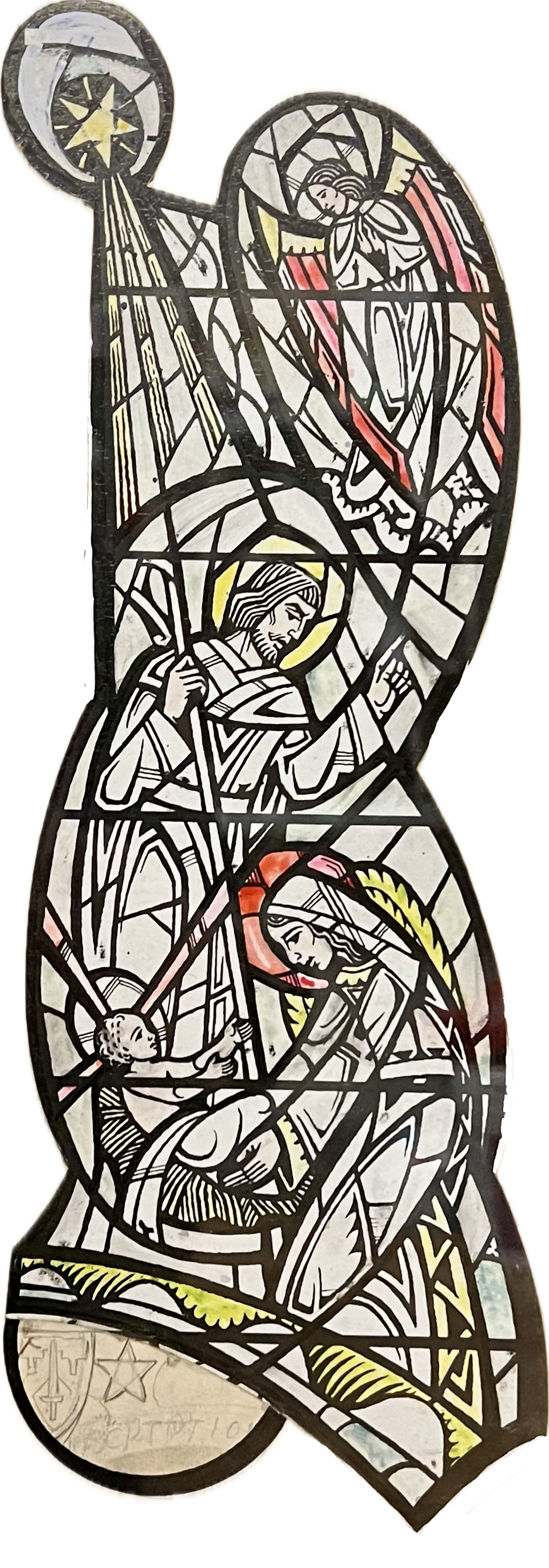
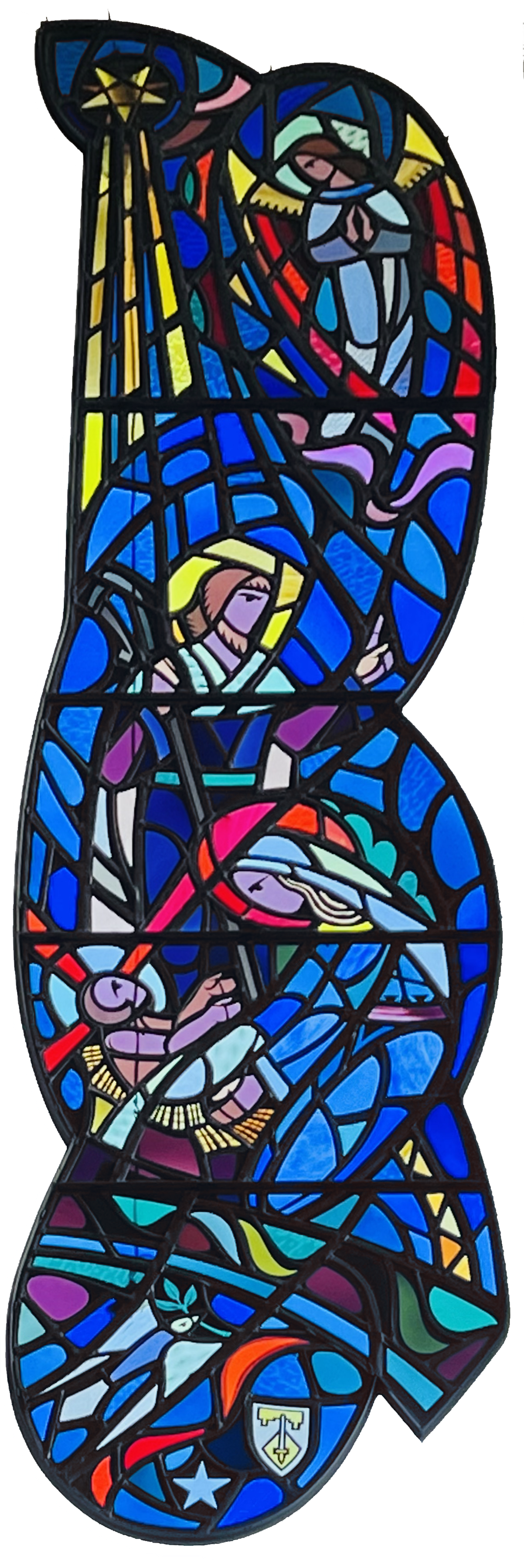
Window No. 1 – The Nativity
(Luke 2:1-20)
Mary, Joseph, and the baby Jesus. The Angel at the top sends rays of light to lead the world to the manger. In the lower section is the Dove of Peace carrying an olive branch, the symbol of peace, flanked by the Bronze Star, awarded to Lt. Dunton on two occasions, and the shoulder patch of Vietnam.
Given in memory of 1st Lt. James Gable Dunton, by his parents, Rear Admiral and Mrs. Lewis W. Dunton.
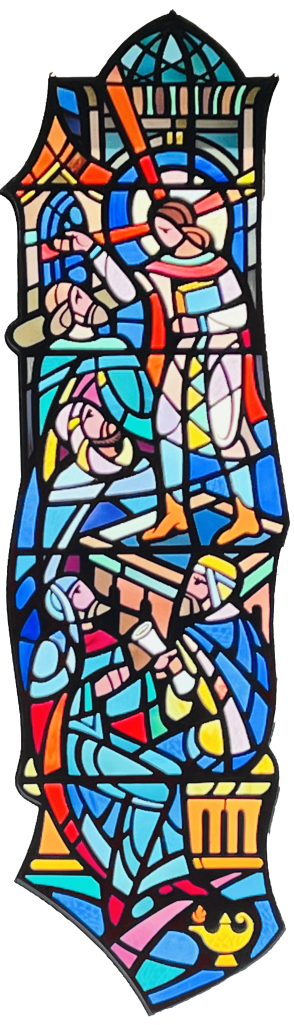
Window No. 2 – Jesus in the Temple
(Luke 2:41-51)
The boy Jesus is in the temple with the teachers, one holding a scroll, a symbol of law and prophecy. In the lower portion is the lamp of knowledge.
Given in memory of Arthur Dodge King and Mrs. Helena Nelson King, by their children, Helena (Mrs. Norman Robinson), Priscilla (Mrs. Willard H. Nutting), Miss Bettina King, and Dr. Nelson D. King.

Window No. 3 – The Baptism of Jesus
(Matthew 3:13-17)
Jesus is being baptized by John the Baptist. The Holy Spirit is shown at the top in the form of a dove, sending a ray onto Jesus. The act of Baptism is indicated by the water descending from the shell held in John the Baptist’s hand. The larger shell at the bottom is the symbol of baptism.
Given in memory of Lucille Page Nespor by her husband, George T. Nespor, and their daughters, Nancy and Barbara.
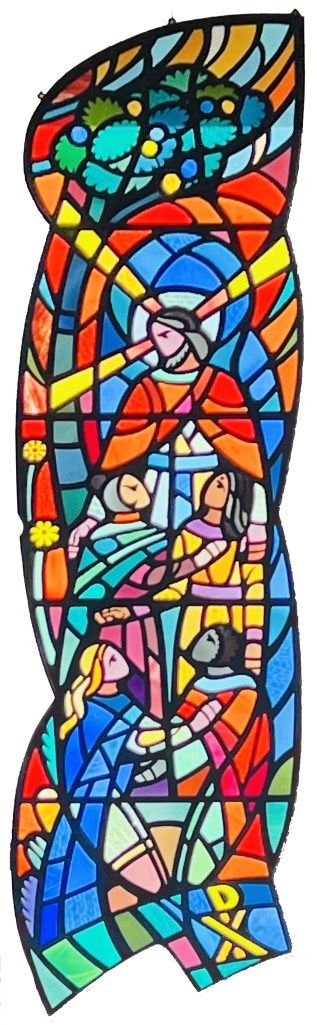
Window No. 4 – Blessing of the Children
(Mark 10:13-16)
Jesus is blessing children of all races from all areas of the world. At the bottom is the monogram, Chi (X) and Rho (P), the first two letters of the Greek word for Christ.
Given in memory of Marguerite Kerr Marcoux (Mrs. William G.) by her family and friends.
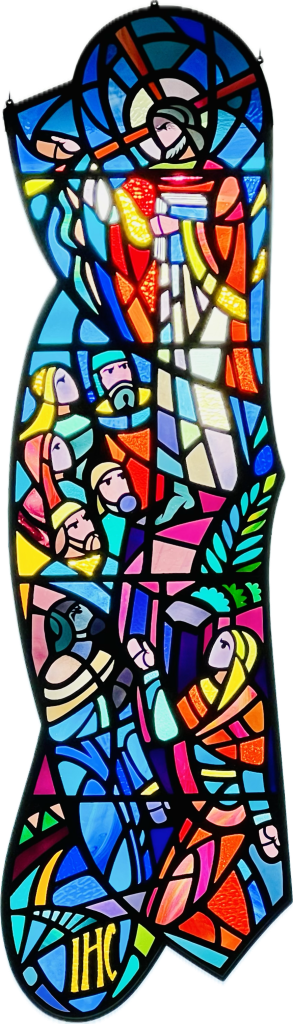
Window No. 5 – The Sermon on the Mount
(Matthew 5:1-12)
Jesus preaches to the disciples and the throngs who came to hear him. At the bottom is a monogram of Christ, “IHC,” the first three letters (iota, eta, sigma) of the Greek spelling of Jesus.
Given in memory of Emerton Manning Margeson and Anna Maude Best Margeson, by Dr. and Mrs. Harold Lorimer Margeson.
Window No. 6 – Healing of the Blind
(John 9:1-9)
Jesus is restoring the sight of the blind. At the bottom is the “Cross Potent,” which is designed as four crutches, symbolic of healing.
Given in memory of Paul Stephen Vaitses and Hazel Holmes Vaitses by their sons, Donald, Allan and Paul.

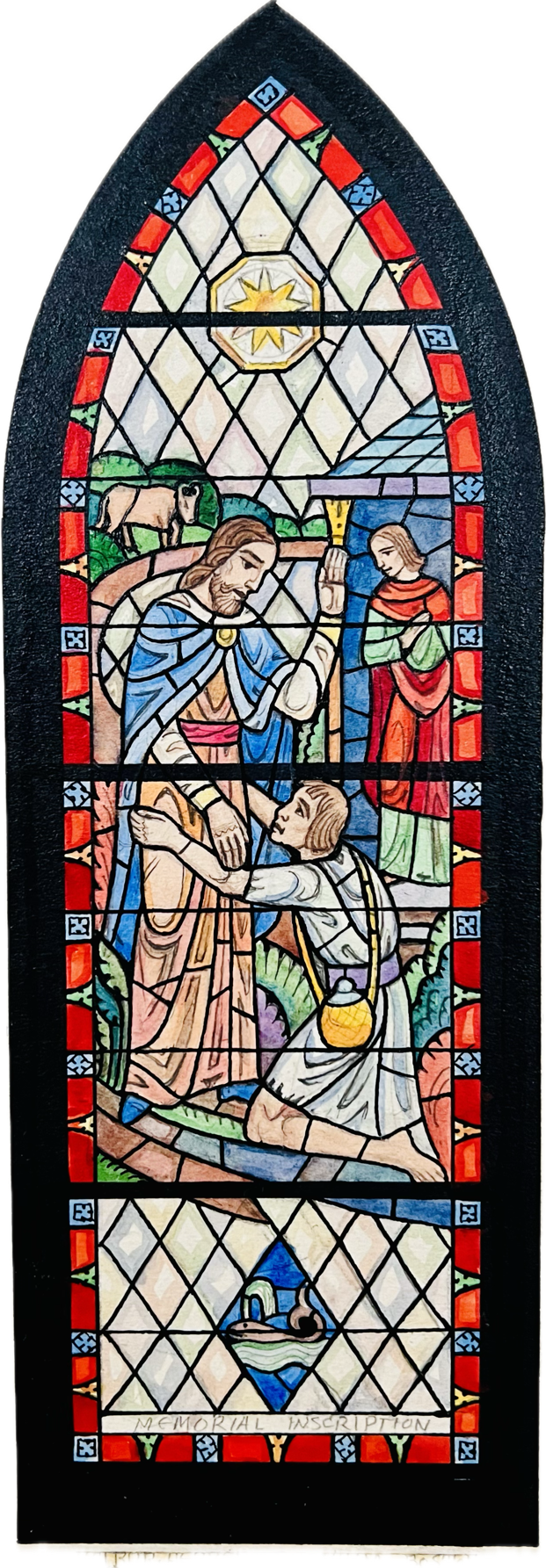
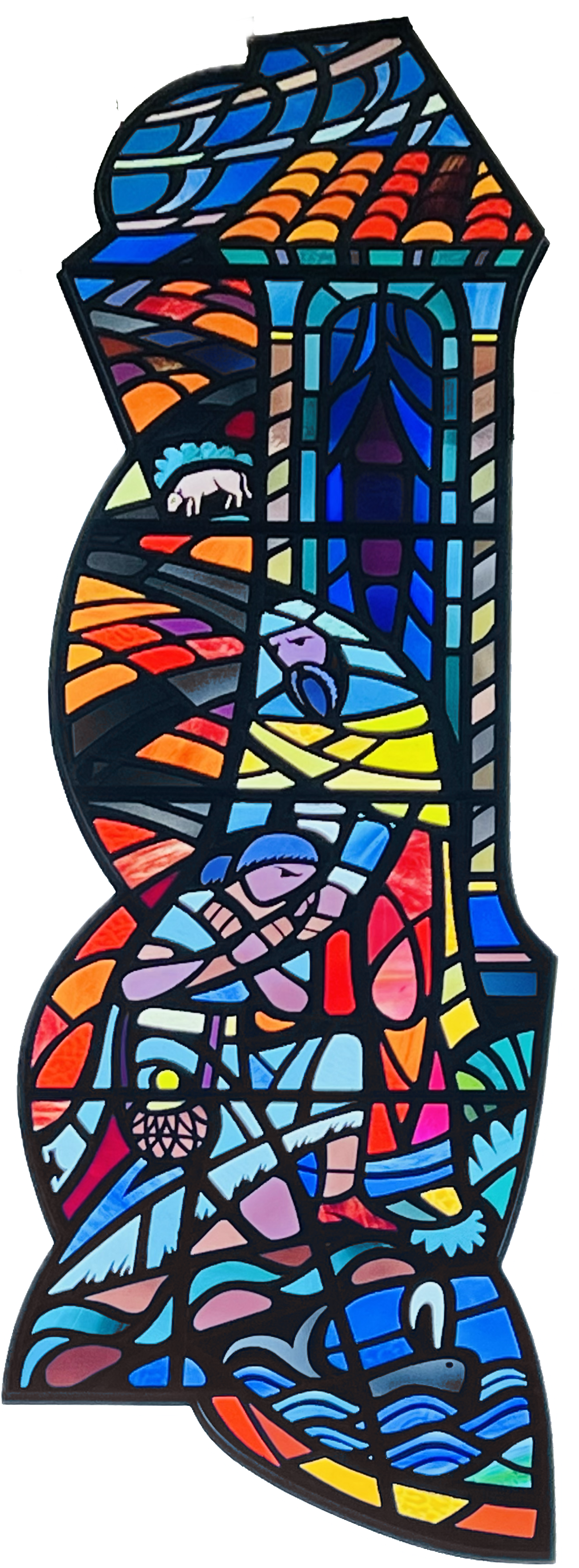
Window No. 7 – Parable of the Prodigal Son
(Luke 15:11-32)
The Prodigal Son is being welcomed home by his father. The fatted calf is in the distance. At the bottom is the whale, symbolic of God’s might and a symbol of forgiveness.
Given by family and friends in memory of Jonathan Henry Atkinson, Garafelia Taylor Atkinson, Robert Taylor Atkinson, Dorothy Atkinson Peabody, William Tyler Peabody, Harold Irving Peabody, Frederick Tyler Peabody, E. Gertrude Bowe Peabody, and Frances T. Warnick Peabody.
Window No. 8 – Parable of the Good Samaritan
(Luke 10:29-37)
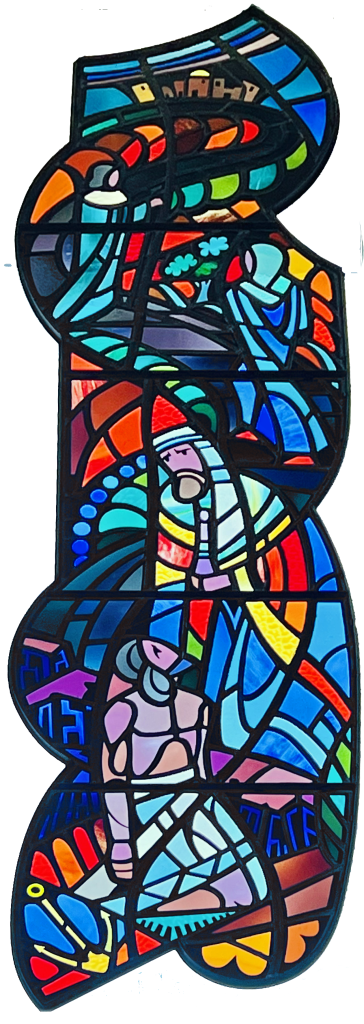
At the top are the Levite and the Priest, who have passed by. The Samaritan cares for the victim. At the bottom is the anchor, the symbol of hope, and in recognition of Robert “Bob” Robertson’s service in the British Navy.
Given in memory of Deacon and Sexton Robert Robertson and Mary Robertson, by their daughters Helen M. Patterson and Edith R. MacAskill and friends.
Window No. 9 – The Last Supper
(John 13:1-20)
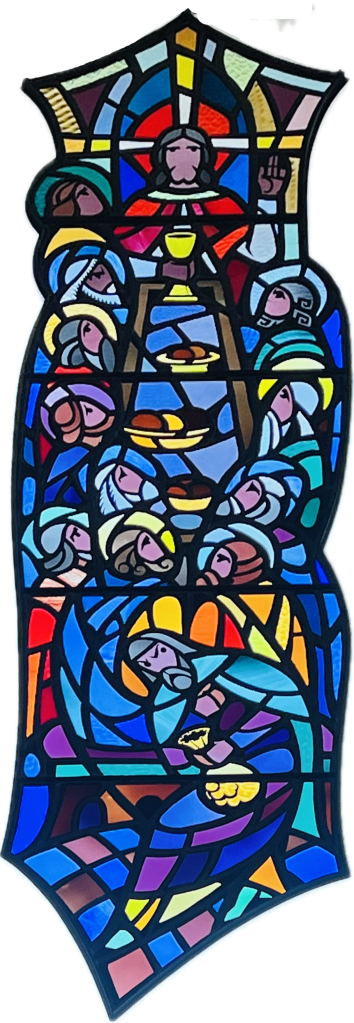
The disciples are at the table, with Judas at the bottom as the betrayer, with the bag of coins, the emblem of the treachery between the Chief Priests and himself. The chalice and bread are symbolic of the blood and body of Jesus.
Given in memory of Elinor Horne Tibbetts by her husband, Percy F. Tibbetts, and their children, Frederick, Frances, and Jean.

Window No. 10 – Garden of Gethsemane
(Matthew 26:36-46)
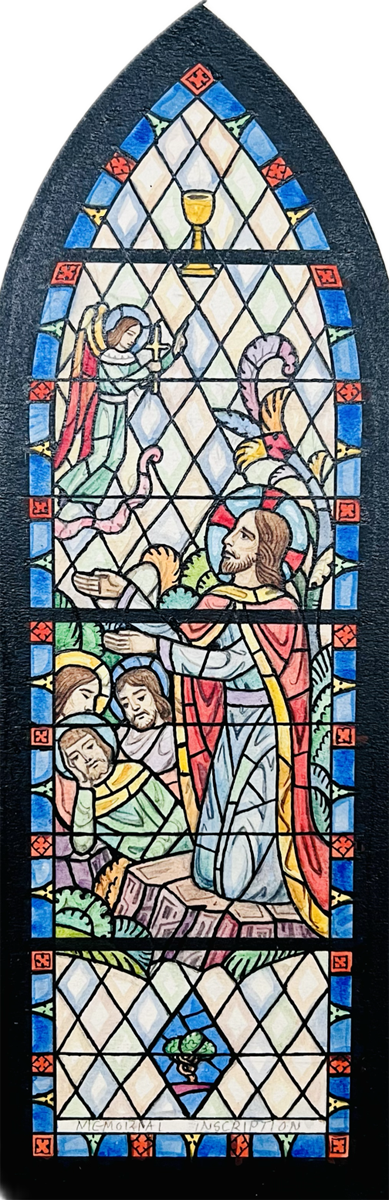
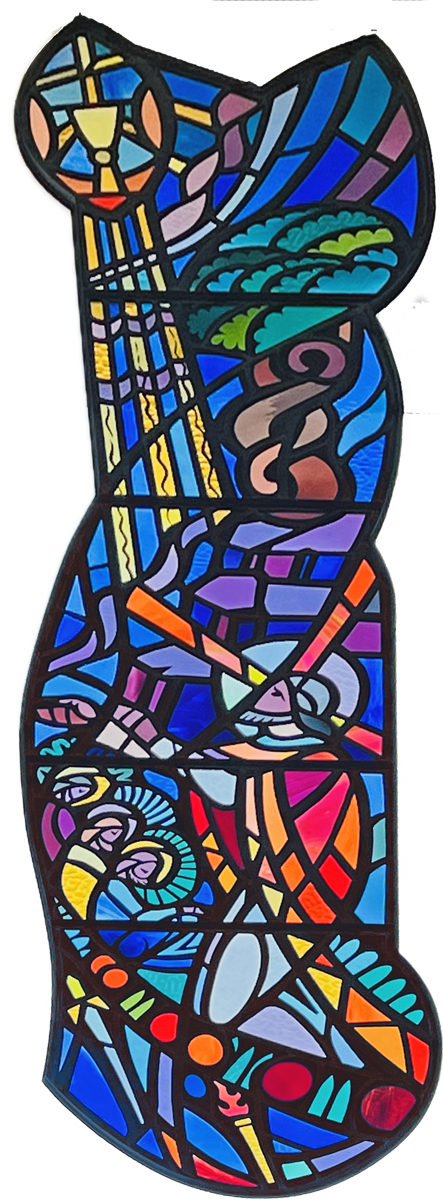
Jesus is praying in the garden and three disciples are asleep. The chalice and cross, symbolic of suffering, are at the top. At the bottom are the sword and the torch, passion symbols.
Given in memory of Edward S. Page and Susie F. Page; by Mrs. Dorothy Page Bidstrup, Mr. and Mrs. John Winslow Lawry, Dotty Ann and Jane, Mr. and Mrs. William Page Dole, Betsy and Kent, Dr. and Mrs. Clark Abt, Mr. and Mrs. Malcolm Dole, Mr. and Mrs. Edward Flint Page and Mrs. Priscilla Page Potter.

Window No. 11 – The Crucifixion
(Mark 15:33-41)
Mary and John grieve at the foot of the cross as Jesus is crucified. Above the cross are the letters “INRI,” meaning Iesus Nazarenus Rex ludaeorum, Jesus of Nazareth; King of the Jews. Under the arms of the cross are the sun and the moon, emblematic of the darkening of the world at noon. Mary’s symbol, the Fleur de Lis, appears on her dress. At the bottom are the three nails, symbolic of Christ’s suffering.
Given in memory of Eula Harriet Gilbert by her husband, Harry A. Gilbert, family and friends.
Window No. 12 – The Resurrection
(Matthew 28:1-10)
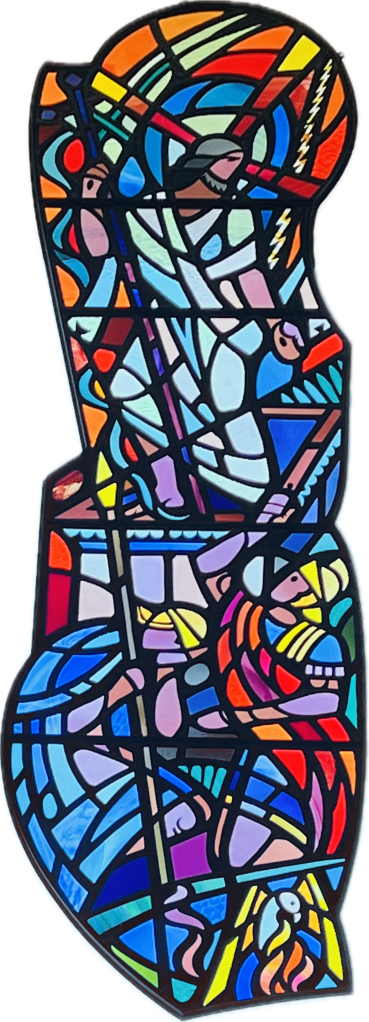
Christ has risen. The two guarding soldiers are present, one asleep and the other astounded. At the bottom is the Phoenix, symbolic of the resurrection and immortal life.
Given in memory of Deacon Horace Loring and Mrs. Christine Loring by their family, Alfred R. Loring, Grace E. Moores, and William M. Loring, Sr.
 First Congregational Church in Melrose, UCC