Narrated by David Reichard
The sculpture “No Man is an Island” was created by Clark Fitz-Gerald (1917-2004) for us here at the First Congregational Church, United Church of Christ, in Melrose, Massachusetts.
The sculpture is based on a quote by English poet John Donne:
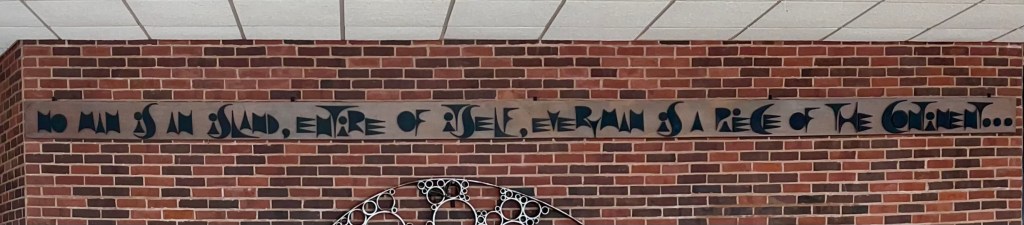
“No man is an island, entire of itself, every man is a piece of the continent, a part of the main.”
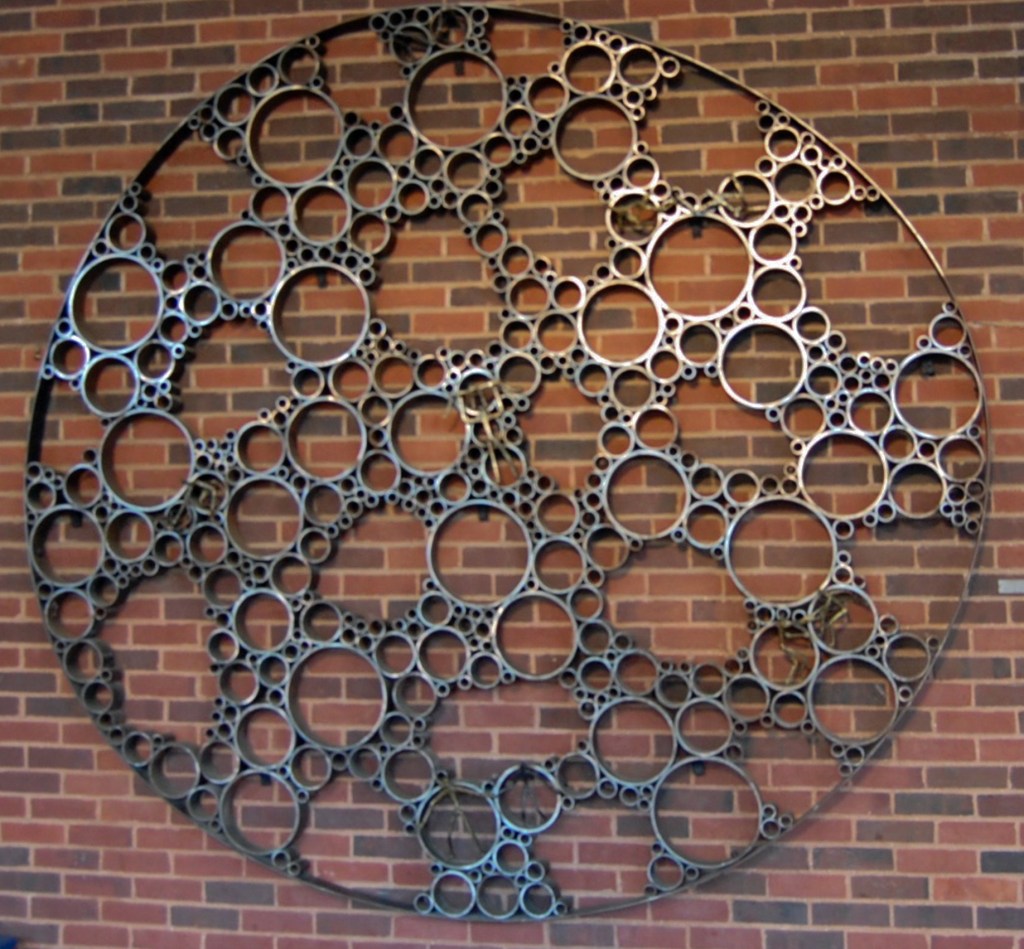
Created of metal pipes of various sizes, and 12 human-like figures, each in pairs, representing humanity’s interdependence.
The imperfect circle and off-center positioning are deliberate, highlighting that no one is perfect or completely self-sufficient.
The sculpture conveys the church’s mission to recognize our shared humanity, interdependence, and the need to love one another. The varied metals and colors represent the diversity of humankind, which should be appreciated, not diminished. Harming others ultimately harms ourselves.
The sculpture acts as a thought-provoking symbol and reminder about loving God and our neighbors as ourselves.
Here is the full description and explanation, excerpted from a sermon preached by Rev. Clarence W. Fuller on April 18, 1971.
“It was obvious almost from the time that the first sketches of the building were drawn that the wall standing so prominently in the Narthex, directly opposite the glass wall where everybody who entered the building via the front entrance would inevitably see it, offered an exciting opportunity to do something creative that would speak to those who entered the building and those who moved about in the Narthex doing the business of the church. When the building was finished, it was even more clear that something had to be there.
“Our architect suggested a banner or a hanging. We talked to a very creative Nun from Connecticut who made banners and hangings. She did some exciting things, but that didn’t seem to be the thing we wanted here. We talked about putting up the cross which had formed part of the reredos in the old building and which had been removed from the building the day after the fire. But, while we can never be confronted too often with what the Cross has to say to us, we already had an abundance of crosses in and on the building of various shapes and designs. (Note: the cross that formed part of the reredos now hangs in the church lounge, the room to the left of the sculpture.)
“Dick Lund, a former member of this church and then an ordained minister in Long Island, suggested we talk to Clark Fitz-Gerald, a sculptor of international reputation who lived in Castine, Maine. I took the initiative and made a date to visit Mr. Fitz-Gerald in Castine. On a beautiful day in July, I drove from our home in (Pemaquid Point) Maine to Castine, carrying with me photographs of the building and of the wall. I found Fitz-Gerald’s house in one of the most gorgeous places in the world, overlooking the whole of Penobscot Bay and facing the open ocean. I also found a good churchman, a member of the Episcopal Church. I found a man who, though he lived in Castine Maine, was very much involved in the world being the father of three, one of whom was fighting in Vietnam, and having just been commissioned to do a piece for Coventry Cathedral in England.
“Fitz-Gerald would not talk with me about the possibilities until he knew something about us as a people, about what we believed, about how we understood our mission as a church, about the ways in which that had worked itself out in the life of the church and of the community. So, we spent the morning talking about theology, the contemporary world, the interests and achievements of our people. Then he said to me “I think I know something about you now. I think I can take it from there.”
“Basically, we had agreed that we wanted something that caught the church’s mission, both its fundamental purpose and the application of it. And the fundamental purpose of the church in the Judean-Christian tradition is to help us love God and our neighbors as ourselves, with all the ramifications of that. Jesus told the great parable of the Good Samaritan as an application of that principle not to obscure the principle. One of the best studies of the nature and purpose of the church concluded that ‘no substitute can be found for the goal of the church as the increase among people of the love of God and neighbor’. If possible, we wanted to be able to say that using something extra-biblical, not because we thought anything less of the bible, but because we have lots of biblical representations of the central theme, in whole or in part, in the building; the stained-glass windows in the sanctuary, for instance.
“So Clark Fitz-Gerald took the commission, mulled over the theme for several weeks, and then sent a sketch and a model. The extra-biblical passage, of course, is John Donne’s familiar quotation from a prose essay. John Donne was an English poet who lived from 1572 to 1631 who gave up the study of law to devote his time to poetry and the study of theology, or as they called it, ‘the body of divinity’. It’s interesting that as long ago as 1601, John Donne, a Roman Catholic, came to the opinion that ‘all churches are beams of one sun’ – certainly an adequate basis for ecumenicity.
“The passage of Donne, and the rest of the sculpture done in metal, caught up the central purpose of the church in a very intriguing way. There are plenty of biblical verses to catch up the theme. But for as long as it will remain there, we will be reminded of something central and essential to the Christian faith, both to encourage and to challenge us.
“…Obviously it says a great many things to a great many people. To some, it may say things that it never said to the artist. That’s an intrinsic quality of good art. Some people have suggested we ought to put a statement next to it, setting forth in a few words what it means, but we agreed we should not do that, since no legend could contain all the things the piece might suggest.
“But let me suggest some of the things I see, maybe some of the things Clark Fitz-Gerald didn’t intend at all, but if beauty – or significance – is in the eye of the beholder, here is part of what I behold.
“One, I see an organic, cellular thing, full of life and meaning. Those pipes are cells of varying sizes, bursting with life and vitality. It makes me think of a drop of water under a microscope, and though the cells on the wall are stationary, I can see them moving as under the microscope. And that speaks to me of creation, of the beginning of things. Whatever was behind that, life evolved, from cellular form, which says something to me of God out of whose being it all came.
“Two, I see this organic thing, the life that exists in the cost elemental and in most complicated forms, is inevitably and inexorably interrelated. ’No man is an island, entire of itself.’ ‘No man lives unto himself and no man dies unto himself.’
“…God has made it inevitable that we touch, that we affect one another. And the mission of the Christian religion is to help us deal positively with our inevitable interrelatedness – to help us to love one another, with all the ramifications of that – to get rid of, or channel, the things that separate us, our hate, our anger, our jealousies, our fears, our covetousness.
“Three, these people who are inevitably a piece of the continent, a part of the main, are of great variety. The metals are different, the colors are different, that’s part of what gives it all its richness.
“The tragedy is that we let ourselves be frozen into our myths and misconceptions, that they become confirmed rather than dissolved…. No one is inferior. The sculpture says that we are equal; we love, we touch, we struggle, we reach out to each other – that’s what’s essential and that, including their various colors, is what enriches the whole as a dark-skinned Jew once taught us it was.
“Four, whatever we do to diminish any of them for whatever reason diminishes us. As John Donne says… ‘if a clod be washed away by the sea, Europe is the less as well as if a promontory were, as well as if a manor of thy friends or of thine own were; any man’s death diminishes me because I am involved in mankind…’”
“Think of that in terms of the race problem, or Vietnam, or the way in which we put other people down. Inevitably we are the losers, we are diminished. Our function in life ought not to be to diminish others and therefore ourselves, but to uplift others and ourselves.
“I’ve said nothing about the imperfections of the circle, or its position off center, which are deliberate, but the sculpture highlights our mission as a church and as Christians, to highlight our interdependence, and to live positively with that reality: ‘Love the Lord your God, and your neighbor as yourself.’”
 First Congregational Church in Melrose, UCC